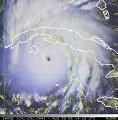
NATL: MELISSA - Models

Moderator: S2k Moderators

Message
Author
USTropics
Professional-Met
Professional-Met
Posts: 2731
Joined: Sun Aug 12, 2007 3:45 am
Location: Florida State University

Re: NATL: MELISSA - Models

#441 Postby USTropics » Sun Oct 26, 2025 4:28 pm

cheezyWXguy wrote:
USTropics wrote:12z HAFS-A coming in (I'm a HAFS-A hugger for Melissa :lol:), it actually increases pressure some until about 8PM ET tonight (relative to what the run started at):
https://i.imgur.com/2MItvl1.png

A new RI period begins shortly after that, with a drop to 931mb in 12 hours (8AM ET):
https://i.imgur.com/zDtdlx6.png

Now that’s been a few hours since you made this post, and now that Melissa has resumed intensification, do you have any ideas as to what particular reason for the hafs’ leveling off and resuming of intensification? Do you think it was able to accurately see the dry air intrusion we observed, and do you think it could be due to the storm’s western inflow channel being blocked from moist inflow by Jamaica to the north? Is the resuming of intensification due to that channel no longer being blocked now that the storm has moved sufficiently westward?
Hope that wasn’t too many questions :lol:


The short answer is, good luck figuring out the physics of a category 4 hurricane :lol: I'll give my opinion on some of your questions:

From 15z (11AM ET) to 18z (2PM ET) it did have a drop in pressure, but then an increase thereafter. A good comparison case is the HAFS-B, which had a smooth decrease in pressure throughout the day (which verified). The main difference here is in initialization, where HAFS-A did not have quite the compact core that HAFS-B did:
Image
Image

If we look at projected IR-simulations for both models 3 hours later, that gives the most clues about the outflow restriction (and core representation) and some of that inflow restriction like you were stating (overdone by the HAFS-A at this timestep):
Image
Image

From actual satellite imagery, we can see which one verified better:
Image


With that said, it was a very brief oscillation on the HAFS-A, and by 8PM tonight it was showing a rapid intensification period again.
8 likes   

BobHarlem
Category 5
Category 5
Posts: 2566
Joined: Thu Oct 20, 2005 6:11 pm

Re: NATL: MELISSA - Models

#442 Postby BobHarlem » Sun Oct 26, 2025 7:31 pm

18z Hurricane models, all but the HWRF landfall's as a cat 5.
HAFS-A
Image
HAFS-B
Image
HWRF
Image
HMON
Image
2 likes   

User avatar
WaveBreaking
Category 2
Category 2
Posts: 708
Joined: Sun Jun 30, 2024 11:33 am
Location: US

Re: NATL: MELISSA - Models

#443 Postby WaveBreaking » Mon Oct 27, 2025 10:04 am

06Z HAFS models are still showing ~154kt landfalls over W Jamaica.

HWRF is at the same location at 124kts.

HMON is at the same location at 141kts.
1 likes   
I am NOT a professional meteorologist, so take all of my posts with a grain of salt. My opinions are mine and mine alone.

User avatar
Teban54
Category 5
Category 5
Posts: 3785
Joined: Sat May 19, 2018 1:19 pm

Re: NATL: MELISSA - Models

#444 Postby Teban54 » Mon Oct 27, 2025 10:28 am

WaveBreaking wrote:06Z HAFS models are still showing ~154kt landfalls over W Jamaica.

HWRF is at the same location at 124kts.

HMON is at the same location at 141kts.

The fact that earlier HAFS-A and HAFS-B runs "only" showed ~130 kt for right now (when Melissa got to 145 kt in reality), yet still had an even stronger landfall, is a bit scary.

On the other hand, IIRC it's not uncommon for the intensities and timings of 1st and 2nd peaks on hurricane models to be "flipped". When Milton formed, the hurricane models generally forecasted its second peak to be stronger than the first. That didn't verify: the actual intensities were 895/155 for the first peak, 902/145 for the second.
3 likes   

User avatar
Kazmit
Category 5
Category 5
Posts: 2258
Age: 22
Joined: Mon Jul 25, 2016 8:49 am
Location: Bermuda

Re: NATL: MELISSA - Models

#445 Postby Kazmit » Mon Oct 27, 2025 11:48 am

One of the worst GFS performances I’ve ever seen for an Atlantic hurricane. Got absolutely nothing right in any aspect, besides sniffing out its development in the first place. It’s gonna need some major upgrades for next season if it wants to be taken seriously.
6 likes   
Igor 2010, Sandy 2012, Fay 2014, Gonzalo 2014, Joaquin 2015, Nicole 2016, Humberto 2019, Imelda 2025

I am only a tropical weather enthusiast. My predictions are not official and may or may not be backed by sound meteorological data. For official information, please refer to the NHC and NWS products.

User avatar
Kazmit
Category 5
Category 5
Posts: 2258
Age: 22
Joined: Mon Jul 25, 2016 8:49 am
Location: Bermuda

Re: NATL: MELISSA - Models

#446 Postby Kazmit » Mon Oct 27, 2025 12:01 pm

The 12z HAFS-A shows an insane 195mph peak this afternoon. This would be on par with Haiyan and surpass Allen to be the strongest Atlantic hurricane on record by wind speed.
3 likes   
Igor 2010, Sandy 2012, Fay 2014, Gonzalo 2014, Joaquin 2015, Nicole 2016, Humberto 2019, Imelda 2025

I am only a tropical weather enthusiast. My predictions are not official and may or may not be backed by sound meteorological data. For official information, please refer to the NHC and NWS products.

User avatar
Teban54
Category 5
Category 5
Posts: 3785
Joined: Sat May 19, 2018 1:19 pm

Re: NATL: MELISSA - Models

#447 Postby Teban54 » Mon Oct 27, 2025 12:09 pm

Kazmit wrote:The 12z HAFS-A shows an insane 195mph peak this afternoon. This would be on par with Haiyan and surpass Allen to be the strongest Atlantic hurricane on record by wind speed.

Insane intensities from these 12z runs:
  • 12z HAFS-A, valid in 3 hrs (15z,11am EDT): 903.5 mb | 171.0 kt
  • 12z HAFS-A, valid in 6 hrs (18z, 2pm EDT): 900.3 mb | 169.2 kt
  • 12z HAFS-B, valid in 6 hrs (18z, 2pm EDT): 892.4 mb | 166.9 kt
  • 12z HMON, valid in 6 hrs (18z, 2pm EDT): 896.9 mb | 159.7 kt
Fortunately, given that a lot of these times have either already passed or will come up very soon, it's fair to say that they won't verify exactly as shown. But still...

HAFS-A and B also continue to show a second round of intensification prior to landfall, after briefly weakening to Cat 4 before then. HAFS-A even shows 162 kt at landfall.
3 likes   

USTropics
Professional-Met
Professional-Met
Posts: 2731
Joined: Sun Aug 12, 2007 3:45 am
Location: Florida State University

Re: NATL: MELISSA - Models

#448 Postby USTropics » Mon Oct 27, 2025 12:57 pm

USTropics wrote:
cheezyWXguy wrote:
USTropics wrote:12z HAFS-A coming in (I'm a HAFS-A hugger for Melissa :lol:), it actually increases pressure some until about 8PM ET tonight (relative to what the run started at):
https://i.imgur.com/2MItvl1.png

A new RI period begins shortly after that, with a drop to 931mb in 12 hours (8AM ET):
https://i.imgur.com/zDtdlx6.png

Now that’s been a few hours since you made this post, and now that Melissa has resumed intensification, do you have any ideas as to what particular reason for the hafs’ leveling off and resuming of intensification? Do you think it was able to accurately see the dry air intrusion we observed, and do you think it could be due to the storm’s western inflow channel being blocked from moist inflow by Jamaica to the north? Is the resuming of intensification due to that channel no longer being blocked now that the storm has moved sufficiently westward?
Hope that wasn’t too many questions :lol:


The short answer is, good luck figuring out the physics of a category 4 hurricane :lol: I'll give my opinion on some of your questions:

From 15z (11AM ET) to 18z (2PM ET) it did have a drop in pressure, but then an increase thereafter. A good comparison case is the HAFS-B, which had a smooth decrease in pressure throughout the day (which verified). The main difference here is in initialization, where HAFS-A did not have quite the compact core that HAFS-B did:
https://i.imgur.com/YDXfAA7.png
https://i.imgur.com/GygG8N3.png

If we look at projected IR-simulations for both models 3 hours later, that gives the most clues about the outflow restriction (and core representation) and some of that inflow restriction like you were stating (overdone by the HAFS-A at this timestep):
https://i.imgur.com/0J0yvW7.png
https://i.imgur.com/pwVJYlr.png

From actual satellite imagery, we can see which one verified better:
https://i.imgur.com/59jqVDh.png


With that said, it was a very brief oscillation on the HAFS-A, and by 8PM tonight it was showing a rapid intensification period again.


I wanted to follow up on this, we moved our usual Friday weather discussion at FSU to Monday (for obvious reasons) so we were able to discuss the pause in intensification that Melissa exhibited yesterday. One of our graduate students deals specifically with this (shoutout to Connor Stoll) and he shared some good insight. If we look at along-shear RH from yesterday during the time period of the intensity level-off, notice this western infringement of drier air (due in part to that undercutting shear). This was the main culprit:

Image

I'll do every 12 hour timesteps to current time, but we can see how this slowly abated throughout the day and into today:
Image

Image

Image

You can find these products here - https://storm.aoml.noaa.gov/viewer/ (under TC Structure -> RH Along Shear).
8 likes   

User avatar
cheezyWXguy
Category 5
Category 5
Posts: 6241
Joined: Mon Feb 13, 2006 12:29 am
Location: Dallas, TX

Re: NATL: MELISSA - Models

#449 Postby cheezyWXguy » Mon Oct 27, 2025 1:50 pm

USTropics wrote:
USTropics wrote:
cheezyWXguy wrote:Now that’s been a few hours since you made this post, and now that Melissa has resumed intensification, do you have any ideas as to what particular reason for the hafs’ leveling off and resuming of intensification? Do you think it was able to accurately see the dry air intrusion we observed, and do you think it could be due to the storm’s western inflow channel being blocked from moist inflow by Jamaica to the north? Is the resuming of intensification due to that channel no longer being blocked now that the storm has moved sufficiently westward?
Hope that wasn’t too many questions :lol:


The short answer is, good luck figuring out the physics of a category 4 hurricane :lol: I'll give my opinion on some of your questions:

From 15z (11AM ET) to 18z (2PM ET) it did have a drop in pressure, but then an increase thereafter. A good comparison case is the HAFS-B, which had a smooth decrease in pressure throughout the day (which verified). The main difference here is in initialization, where HAFS-A did not have quite the compact core that HAFS-B did:
https://i.imgur.com/YDXfAA7.png
https://i.imgur.com/GygG8N3.png

If we look at projected IR-simulations for both models 3 hours later, that gives the most clues about the outflow restriction (and core representation) and some of that inflow restriction like you were stating (overdone by the HAFS-A at this timestep):
https://i.imgur.com/0J0yvW7.png
https://i.imgur.com/pwVJYlr.png

From actual satellite imagery, we can see which one verified better:
https://i.imgur.com/59jqVDh.png


With that said, it was a very brief oscillation on the HAFS-A, and by 8PM tonight it was showing a rapid intensification period again.


I wanted to follow up on this, we moved our usual Friday weather discussion at FSU to Monday (for obvious reasons) so we were able to discuss the pause in intensification that Melissa exhibited yesterday. One of our graduate students deals specifically with this (shoutout to Connor Stoll) and he shared some good insight. If we look at along-shear RH from yesterday during the time period of the intensity level-off, notice this western infringement of drier air (due in part to that undercutting shear). This was the main culprit:

https://i.imgur.com/u4qudoU.gif

I'll do every 12 hour timesteps to current time, but we can see how this slowly abated throughout the day and into today:
https://i.imgur.com/7IyToeo.gif

https://i.imgur.com/Tq0fB8L.gif

https://i.imgur.com/Oh6UoST.gif

You can find these products here - https://storm.aoml.noaa.gov/viewer/ (under TC Structure -> RH Along Shear).

Thanks for the double reply! A lot of interesting information here.
2 likes   

User avatar
Hurricane2022
Category 5
Category 5
Posts: 1949
Joined: Tue Aug 23, 2022 11:38 pm
Location: Araçatuba, Brazil

Re: NATL: MELISSA - Models

#450 Postby Hurricane2022 » Mon Oct 27, 2025 6:18 pm

3 likes   
Sorry for the bad English sometimes...!
For reliable and detailed information for any meteorological phenomenon, please consult the National Hurricane Center, Joint Typhoon Warning Center , or your local Meteo Center.

--------

ECCE OMNIA NOVA FACIAM (Ap 21,5).

User avatar
Teban54
Category 5
Category 5
Posts: 3785
Joined: Sat May 19, 2018 1:19 pm

Re: NATL: MELISSA - Models

#451 Postby Teban54 » Mon Oct 27, 2025 6:34 pm


18z HAFS-A:
  • Peak: 03z (11pm EDT), 895.5 mb | 176.6 kt
  • Landfall: 15z (11am EDT), 905.3 mb | 162.3 kt
18z HAFS-B:
  • Min pressure: 06z (2am EDT), 898.2 mb | 133.1 kt
  • Max wind speed & just before landfall: 12z (8am EDT), 907.5 mb | 154.8 kt
2 likes   

User avatar
Kazmit
Category 5
Category 5
Posts: 2258
Age: 22
Joined: Mon Jul 25, 2016 8:49 am
Location: Bermuda

Re: NATL: MELISSA - Models

#452 Postby Kazmit » Mon Oct 27, 2025 7:16 pm

Teban54 wrote:

18z HAFS-A:
  • Peak: 03z (11pm EDT), 895.5 mb | 176.6 kt
  • Landfall: 15z (11am EDT), 905.3 mb | 162.3 kt
18z HAFS-B:
  • Min pressure: 06z (2am EDT), 898.2 mb | 133.1 kt
  • Max wind speed & just before landfall: 12z (8am EDT), 907.5 mb | 154.8 kt

HAFS-A with a 200 mph peak. :froze:
1 likes   
Igor 2010, Sandy 2012, Fay 2014, Gonzalo 2014, Joaquin 2015, Nicole 2016, Humberto 2019, Imelda 2025

I am only a tropical weather enthusiast. My predictions are not official and may or may not be backed by sound meteorological data. For official information, please refer to the NHC and NWS products.

User avatar
Kazmit
Category 5
Category 5
Posts: 2258
Age: 22
Joined: Mon Jul 25, 2016 8:49 am
Location: Bermuda

Re: NATL: MELISSA - Models

#453 Postby Kazmit » Mon Oct 27, 2025 7:30 pm

Both HAFS models also reintensify Melissa back to major hurricane strength en route to Bermuda. Maybe some baroclinic enhancement from the trough?
3 likes   
Igor 2010, Sandy 2012, Fay 2014, Gonzalo 2014, Joaquin 2015, Nicole 2016, Humberto 2019, Imelda 2025

I am only a tropical weather enthusiast. My predictions are not official and may or may not be backed by sound meteorological data. For official information, please refer to the NHC and NWS products.

Pelicane
Tropical Storm
Tropical Storm
Posts: 190
Joined: Tue Sep 13, 2022 1:52 pm
Location: Lafayette, Louisiana

Re: NATL: MELISSA - Models

#454 Postby Pelicane » Tue Oct 28, 2025 12:57 am

This is the strongest depiction I've seen the HAFS model spit out for a storm. Obviously very overcooked, but in model land this is a record-breaking 220 mph storm currently. Does eventually landfall around the current intensity, but just thought I'd share because of how absurd it is.

Image
3 likes   

jlauderdal
S2K Supporter
S2K Supporter
Posts: 7240
Joined: Wed May 19, 2004 5:46 am
Location: NE Fort Lauderdale
Contact:

Re: NATL: MELISSA - Models

#455 Postby jlauderdal » Tue Oct 28, 2025 9:16 am

Pelicane wrote:This is the strongest depiction I've seen the HAFS model spit out for a storm. Obviously very overcooked, but in model land this is a record-breaking 220 mph storm currently. Does eventually landfall around the current intensity, but just thought I'd share because of how absurd it is.

https://i.imgur.com/y5LgxEJ.png

Not too overdone in the final analysis.
5 likes   

User avatar
cycloneye
Admin
Admin
Posts: 148541
Age: 69
Joined: Thu Oct 10, 2002 10:54 am
Location: San Juan, Puerto Rico

Re: NATL: MELISSA - Models

#456 Postby cycloneye » Tue Oct 28, 2025 12:31 pm

By far HAFS-A wins the crown as the best one that predicted the final intensity peak. This was 6 days ago when Melissa was still a tropical storm.

Image
5 likes   
Visit the Caribbean-Central America Weather Thread where you can find at first post web cams,radars
and observations from Caribbean basin members Click Here

tomatkins
Tropical Storm
Tropical Storm
Posts: 233
Joined: Wed Sep 05, 2018 2:11 pm

Re: NATL: MELISSA - Models

#457 Postby tomatkins » Tue Oct 28, 2025 12:48 pm

12Z hurricane models are out. ALl of the initated too far east (land fall to the east of Black River) so they will likely have more time over land than the actual outcome. All landfall around Chivrico (west of Santiago de Cuba) sometime around 6-9Z tomorrow.

HWRF - landfall at 927 mb, 123 kt
HMON - landfall at 958 mb, 96 kt
HAFS-A - landfall at 935 mb, 112 kt
HAFS-B - landfall at 953 mb, 93 kt.

None of the models show any singificant strengthening post-Jamaica. All emerge from Cuba in the 950-970 range before striking the relatively unpopular southern Bahamas and then scooting west of Bermuda and out to sea.

CMC still has a Newfoundland strike for the post-tropical remnants, while ICON and GFS turn east south of Newfoundland.
2 likes   

MEANINGLESS_NUMBERS
Category 2
Category 2
Posts: 502
Joined: Mon Nov 02, 2020 1:43 pm

Re: NATL: MELISSA - Models

#458 Postby MEANINGLESS_NUMBERS » Tue Oct 28, 2025 12:57 pm

HWRF showing Cat 4 landfall in Bermuda:

Image

This would be the strongest landfall in living memory.
3 likes   
Emily '87, Felix '95, Gert '99, Fabian '03, Humberto '19, Paulette '20, Teddy '20, Fiona '22, Lee '23, Ernesto '24, Humberto/Imelda '25

User avatar
GCANE
S2K Supporter
S2K Supporter
Posts: 12072
Joined: Mon Oct 22, 2007 8:03 am

Re: NATL: MELISSA - Models

#459 Postby GCANE » Tue Oct 28, 2025 3:20 pm

2 likes   

User avatar
Beef Stew
Category 2
Category 2
Posts: 642
Joined: Sat May 30, 2020 11:31 am
Location: South Florida

Re: NATL: MELISSA - Models

#460 Postby Beef Stew » Wed Oct 29, 2025 7:09 am

Melissa will go down as a massive win for the HAFS A/B, and especially Google DeepMind (...not to mention a huge L for the GFS). Yes, you could argue that the HAFS models have tended to have a desire to blow most storms up in the few years since they've been introduced (showing more intense peaks for storms like Helene, Lee, etc. than actually occurred), but ultimately the difference we've seen in the accuracy of intensity forecasts and modeled RI has been really significant from even the late 2010's. While intensity is still hard to predict, the strides we've made in recent years really stand out to me.
5 likes   


Return to “2025”

Who is online

Users browsing this forum: No registered users and 38 guests